Semantic clarity helps AI understand your content by making your message clear, structured, and aligned with user intent. Without it, even well-written content can be misunderstood or overlooked in AI-driven search results.
Your content might be optimized… but still be invisible in AI search results.
I remember when SEO was all about single keywords. That’s how I started—pick a phrase, repeat it a few times, and hope for the best. But today’s landscape is different. With the rise of AI Overviews (AIO), it’s no longer about keywords alone—it’s all about semantic clarity.
Google’s algorithms now prioritize meaning over matching. Writers and SMBs can no longer rely on keyword placement. Search has evolved to ensure that your content is clear, relevant, and easily understood by humans and AI systems. That’s where semantic clarity in AIO comes into play.
Many content creators assume that if their writing sounds good, it will perform well in search. But AI systems don’t interpret content the same way humans do. If your message isn’t structured clearly and tied to a specific intent, it can be misunderstood or overlooked entirely. This is where semantic clarity becomes critical.
What Is Semantic Clarity in AIO?
Here’s where most content creators get it wrong…
It’s how well your content expresses meaning in a way Google’s AI systems can understand. It’s not about fancy language or keyword repetition. Instead, practice using structure, context, and intent to make your message unmistakably clear.
When Google selects content for AI Overviews or Featured Snippets, it’s scanning for content that:
- Clearly answers a specific question
- Aligns with the user’s search intent
- Demonstrates topical depth and relevance
Clarifying the Confusion Over Semantic Terms
You may have heard another term related to semantic clarity—semantic SEO (Search Engine Optimization). These terms are not the same. Let’s look at the difference:
- Semantic SEO is about depth. It aims to optimize content in a way that shows a comprehensive understanding of a topic—using related terms, entities, and natural language to build topical authority.
- Semantic clarity, on the other hand, is about precision. It focuses on how clearly and meaningfully your content communicates an idea—especially when AI is trying to determine the best short-form answer.
For example, my newsletters—AI Content Visionary and Pam’s Insightful Pen, as well as my LinkedIn newsletter, Design Visibility Insights—often take deep dives into specific topics. That depth makes them strong examples of semantic SEO in action.
But when it comes to semantic clarity in AIO, the goal shifts.
Your content doesn’t need to cover everything about a topic like semantic SEO might require. Instead, it needs to convey a focused answer with high clarity and low ambiguity, and it needs to be written in your own words, from your unique point of view.
This is what helps your content stand out in AI Overviews: not keyword density, but the clarity of your message.
Why Keywords Alone No Longer Work?
Old-school SEO matched words, not meaning, and that was a problem.
It often returned results that looked right but didn’t sound right. Google’s goal has always been to deliver better answers, not just closer matches. That’s why it made the shift to semantic clarity.
Today’s search engine reads more like a human. It ranks content based on what it means, not just what it says.
When your content lacks clarity or has too many disconnected ideas, AI can’t grasp the point. But when your content flows logically and stays focused, it helps both people and search engines get what you’re saying.
Think of it this way:
Old SEO = Writing for the algorithm.
Modern SEO = Writing with clarity, purpose, and precision.
The Benefits of Semantic Clarity in Search
By shifting to a semantic model, Google has enhanced its ability to match content with what users actually mean. Here’s what that looks like in practice:
- Better relevance – Results reflect search intent, not just literal word matches.
- Enhanced user experience – Users can find what they need faster without guessing exact phrases.
- Smarter handling of complex queries – Google can interpret layered questions and return nuanced results.
- Higher content discoverability – Pages are surfaced based on overall topical relevance, not keyword density.
How to Improve Semantic Clarity in Your Content
You don’t have to oversimplify to be understood—but you do need to make your content easy to follow.
Start with these actionable steps:
- Use clear headings and subheadings to guide readers and search engines.
- Avoid keyword stuffing. Focus on natural phrasing and logical flow.
- Define your terms, especially in niche or technical topics.
- Establish topical authority by exploring related subtopics and linking them logically.
- Answer the “why” and “how,” not just the “what.”
Think of writing like teaching. The simpler and clearer your explanation, the more people (and search engines) will understand.
Optimizing Content for AI Overviews and Semantic SEO
AI Overviews are designed to surface direct, trustworthy answers at a glance. That is why your formatting matters just as much as your message.
To create content that’s both AIO-ready and reader-friendly:
- Use bulleted lists, numbered steps, and clear subheadings.
- Create meaningful internal links between related topics.
- Write with the reader’s intent in mind—make sure every section answers a specific need.
- Avoid vague generalities; specificity improves clarity.
These formatting tactics not only support semantic clarity but also increase your chances of appearing in high-visibility search features like AI Overviews and Featured Snippets.
This formatting mindset is at the heart of what’s now known as Answer Engine Optimization or AEO.
The Evolution into Answer Engine Optimization
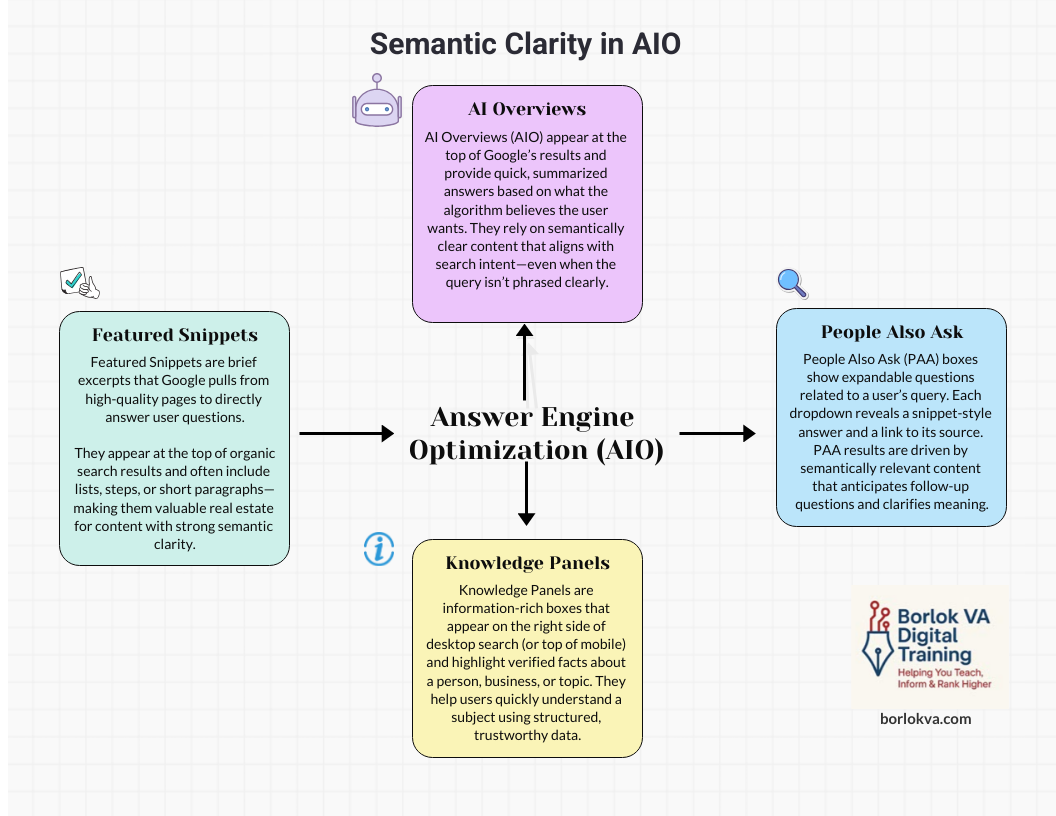
This is part of a broader movement toward Answer Engine Optimization (AEO)—where SMBs and content writers create content specifically designed to be selected for AI Overviews, Featured Snippets, People Also Ask boxes, and Knowledge Panels.
The more your content aligns with semantic clarity in AIO, the more likely it is to appear in these high-visibility spots.
📊 The diagram below shows how semantic clarity connects your content to modern search features driven by AEO strategies:
📌 Want to see these strategies in action? Read my guide: How SMBs Can Gain Featured Snippet Position.
AEO is where SMBs and content writers can shine. By focusing on semantic clarity in AIO, you can compete against larger corporations that rely on sheer volume. But you can win by focusing on quality—using the strategies you’ve just learned to compete smarter, not louder.
Final Thoughts: Write for Meaning, Not Just Machines
The future of SEO lies in understanding, not just visibility. If your content lacks semantic clarity, it won’t show up where it matters most—regardless of how many keywords you’ve packed in.
As Google continues to evolve, so should your strategy.
Whether you’re writing blogs, training materials, or service pages, make clarity your goal. The clearer your message, the more valuable your content becomes—to both search engines and the people reading it.
If your content isn’t showing up where it should, semantic clarity is often the missing piece. If you want help identifying where your content is falling short, reach out to Borlok VA Digital Training. I’d be happy to help.
📅 Published on September 21, 2025; updated April 20, 2026
Pam Lokker is the founder of Borlok VA Digital Training, a division of Borlok Virtual Assistants, LLC, where she helps businesses and creators improve visibility through clear, structured, and SEO-driven content. She specializes in semantic clarity, AI visibility, and content strategy for today’s evolving search landscape.
She is also the creator of Pam’s Insightful Pen, AI Content Visionary, and Design Visibility Insights, where she shares practical insights for digital writers and business owners.